
Investing in the Tehran Stock Exchange

The Tehran Stock Exchange (TSE) is Iran's primary regulated financial marketplace, offering Iranian investors access to publicly listed companies, investment funds, and fixed-income instruments. Established in 1967, the TSE has grown into one of the most active stock exchanges in the Middle East by number of listed companies — and in recent years, by retail investor participation.
In this guide — updated for 2026 — we cover everything an investor needs to know about the Tehran Stock Exchange: how it works, how to open a trading account, what instruments are available, how the TEDPIX index functions, proven investing strategies, key risks, and how the TSE compares to international markets accessible to Iranian investors.
How the Tehran Stock Exchange Works
The Tehran Stock Exchange operates as a regulated marketplace where buyers and sellers transact in shares of publicly listed Iranian companies. The exchange is supervised by the Securities and Exchange Organization of Iran (SEO), which sets listing requirements, trading rules, and investor protection standards.
Trading Hours
The TSE operates Saturday through Wednesday — aligned with the Iranian working week. Trading sessions run in two phases:
- Pre-market session: 08:30 – 09:00 (order entry, no execution)
- Main trading session: 09:00 – 12:30 (continuous auction)
The exchange is closed on Thursdays, Fridays, and Iranian public holidays. This schedule differs significantly from Western exchanges and international forex markets, which operate five days a week around the clock.
Market Structure
The TSE is divided into two main boards:
- First Market (Board 1): Large, established companies with strong financial track records. Stricter listing requirements.
- Second Market (Board 2): Smaller and newer companies. Lower listing thresholds, higher growth potential, and higher risk.
In addition to the TSE, Iran operates the Iran Fara Bourse (IFB) — an over-the-counter market for smaller companies, bonds, and investment funds that do not meet TSE listing requirements.
Price Limits
The TSE imposes daily price movement limits to reduce volatility. Most shares have a ±5% daily price limit — meaning a stock cannot rise or fall more than 5% from its previous closing price in a single session. This mechanism protects retail investors from extreme intraday swings but can also trap investors in positions during sharp market moves.
The TEDPIX — Tehran Stock Exchange Index
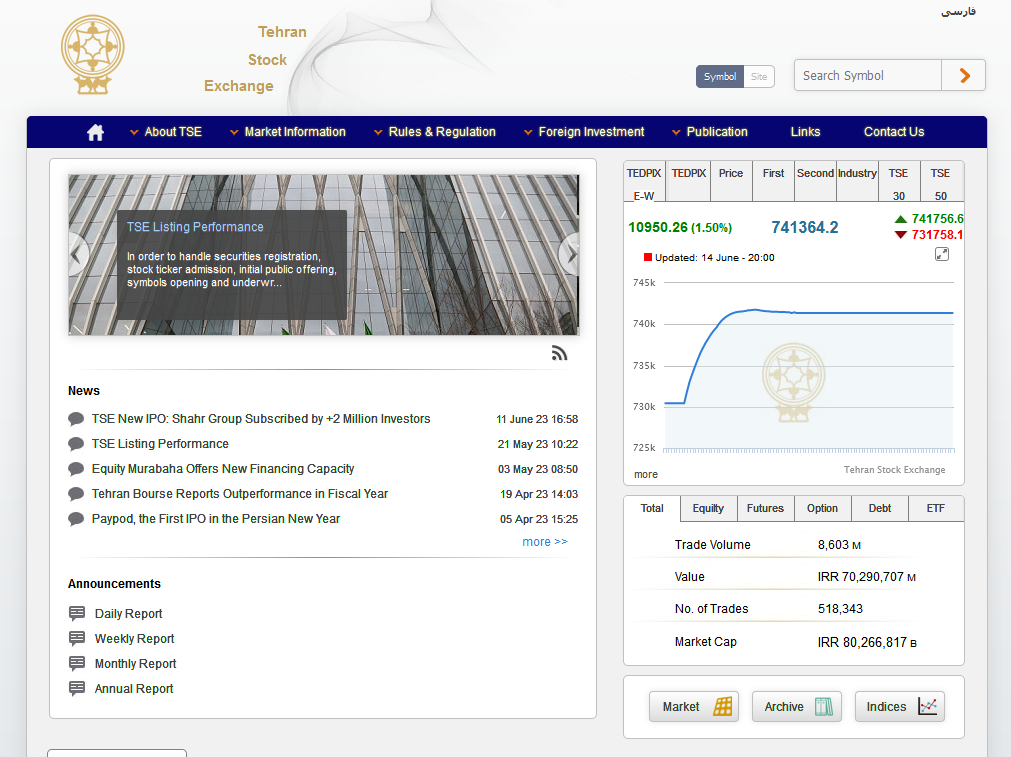
The TEDPIX (Tehran Stock Exchange Dividend and Price Index) is the main benchmark index of the TSE. It tracks the total return — including dividends — of all listed companies on the exchange, weighted by market capitalisation.
Key characteristics of the TEDPIX:
- Covers all companies listed on the TSE — currently over 700 companies
- Denominated in Iranian Rials (IRR)
- Highly sensitive to oil prices, government policy, and currency movements
- Experienced extreme volatility between 2019–2022 due to sanctions, inflation, and currency devaluation
- Peaked at over 2,000,000 points in August 2020 before a sharp correction
⚠ Important: TEDPIX gains can be misleading in real terms. A significant portion of the index's nominal gains in recent years has been driven by inflation and Rial devaluation rather than genuine economic growth. Always evaluate TSE investments in USD or gold terms as well as Rial terms.
How to Invest in the Tehran Stock Exchange — Step by Step
Step 1 — Obtain a SEJAM Code
Every investor in Iran must register with the Central Securities Depository of Iran (CSDI) to receive a unique investor identification code called a SEJAM code (کد سجام). This is mandatory for all stock market activity in Iran.
- Register online at sejam.ir using your national ID (کد ملی)
- Complete identity verification (in-person or via authentication app)
- Receive your SEJAM code — typically within 1–3 business days
Step 2 — Open a Trading Account (کد بورسی)
After receiving your SEJAM code, open a brokerage account with a licensed TSE broker. You will receive a stock trading code (کد بورسی) which identifies you as an investor on the exchange.
- Choose a licensed broker from the list approved by the SEO
- Submit identity documents and bank account details
- Account opening is typically completed within 2–5 business days
Step 3 — Fund Your Brokerage Account
Deposit funds into your brokerage account via Iranian bank transfer. Most brokers support direct bank transfers from major Iranian banks. There is no minimum deposit requirement set by the exchange, though individual brokers may set their own minimums.
Step 4 — Research and Select Stocks
Before placing any orders, conduct thorough research. Key sources for TSE company data include:
- Codal (codal.ir): Official financial disclosure platform — all listed companies publish financial statements, auditor reports, and material news here
- TSETMC (tsetmc.com): Real-time market data, price history, order book depth
- Fipiran (fipiran.com): Fund performance, bond data, and market analytics
Step 5 — Place Your Order
Through your broker's online trading platform or mobile app, place buy orders during the trading session (09:00–12:30 Saturday to Wednesday). You can place:
- Market orders: Execute immediately at the best available price
- Limit orders: Execute only at your specified price or better
Step 6 — Settlement
TSE trades settle on a T+2 basis — shares are transferred to your depository account and cash is settled two business days after the trade date. This is standard for most regulated stock exchanges globally.
What Can You Trade on the Tehran Stock Exchange?
| Instrument | Description | Risk Level |
|---|---|---|
| Common Shares (سهام عادی) | Ownership stakes in listed Iranian companies | Medium–High |
| Investment Fund Units (صندوق سرمایهگذاری) | Managed funds investing in stocks, bonds, or mixed assets | Low–Medium |
| Government Bonds (اوراق دولتی) | Fixed-income securities issued by the Iranian government | Low |
| Corporate Bonds (اوراق شرکتی) | Fixed-income securities issued by listed companies | Low–Medium |
| ETFs (صندوق ETF) | Exchange-traded funds tracking indices or sectors | Medium |
| Rights Issues (حق تقدم) | Preemptive rights issued to existing shareholders in capital raises | High |
Investing Strategies for the Tehran Stock Exchange
1. Value Investing
Look for companies trading below their intrinsic value — low P/E ratios relative to sector peers, strong cash flow, and low debt. In the TSE, export-oriented industries (petrochemicals, metals, mining) often offer better value metrics than domestically-focused consumer goods companies during periods of Rial weakness, since their revenues are effectively dollar-denominated.
2. Inflation-Resistant Sectors
In an economy with persistently high inflation, certain sectors preserve value better than others. Historically on the TSE, the strongest inflation-resistant sectors have been:
- Petrochemicals — revenues tied to global commodity prices
- Metals and Mining (steel, copper, zinc) — hard asset exposure
- Banking — benefits from higher interest rates in inflationary environments
- Real estate investment funds — direct exposure to property price appreciation
3. Dollar-Cost Averaging (DCA)
Rather than investing a lump sum, invest a fixed Rial amount monthly regardless of market conditions. This reduces the impact of TEDPIX volatility on your average entry price and removes the psychological pressure of trying to time the market.
4. Diversification Across Markets
One of the most important strategies for Iranian investors is not limiting exposure to the TSE alone. The TSE is heavily influenced by domestic policy decisions, oil prices, and Rial movements — factors outside any individual investor's control.
Many experienced Iranian investors diversify across both the TSE and international markets. Access to global forex and CFD markets is available through offshore brokers — for example, dedicated forex platforms built for Iranian traders provide access to gold (XAU/USD), global indices, and currency pairs as a complement to TSE holdings.
5. Investment Funds for Beginners
For new investors, TSE-listed equity investment funds (صندوق سهامی) offer a managed, diversified entry point. Professional fund managers handle stock selection and rebalancing. Returns generally track the TEDPIX with lower individual stock risk.
Key Risks of Investing in the Tehran Stock Exchange
- Currency risk: All TSE investments are Rial-denominated. If the Rial depreciates against the dollar — as it has done persistently — nominal gains can be wiped out in hard currency terms.
- Sanctions risk: Changes in international sanctions can rapidly affect investor sentiment, oil revenues, and the availability of foreign currency — all of which directly impact TSE valuations.
- Liquidity risk: Daily ±5% price limits can create illiquidity — if a stock is limit-down for multiple consecutive days, selling may be impossible.
- Concentration risk: The TSE is heavily weighted toward a small number of large petrochemical, metal, and banking companies. Poor performance in these sectors drags the entire index.
- Political risk: Domestic policy changes, budget decisions, and geopolitical developments can trigger sharp market moves with little warning.
- Information asymmetry: Despite the Codal disclosure system, insider trading and delayed disclosure remain concerns on the TSE.
Tehran Stock Exchange vs International Forex Markets
Many Iranian investors choose between the TSE and international forex markets — or use both as part of a broader portfolio strategy. Here is how they compare:
| Factor | Tehran Stock Exchange | International Forex Market |
|---|---|---|
| Currency | Iranian Rial (IRR) | USD, EUR, GBP and others |
| Trading hours | Sat–Wed, 09:00–12:30 | 24 hours, Mon–Fri |
| Access | Iranian residents only | Via offshore broker (USDT deposit) |
| Inflation hedge | Partial (Rial-denominated) | Strong (USD-denominated) |
| Leverage | None (cash only) | Up to 1:1000 |
| Instruments | Stocks, bonds, funds | Forex, gold, oil, indices, crypto |
| Deposit method | Iranian bank transfer | USDT, Perfect Money, crypto |
| Regulatory oversight | SEO Iran | Offshore (SVG, Seychelles, Belize) |
Frequently Asked Questions
Can foreigners invest in the Tehran Stock Exchange?
Foreign nationals can invest in the TSE, but the process is complex. They must obtain a trading code through the SEO, open an account with a licensed Iranian broker, and navigate currency repatriation restrictions. In practice, most foreign investors access Iranian equities through country funds rather than directly.
What is the TEDPIX index?
The TEDPIX (Tehran Stock Exchange Dividend and Price Index) is the main benchmark index of the TSE. It tracks the total return — price appreciation plus dividends — of all companies listed on the exchange, weighted by market capitalisation. It is denominated in Iranian Rials.
What is a SEJAM code and how do I get one?
A SEJAM code is a unique investor identification number required for all stock market activity in Iran. You can register at sejam.ir using your national ID (کد ملی). The process is completed online and the code is typically issued within 1–3 business days.
Is the Tehran Stock Exchange safe to invest in?
The TSE is a regulated exchange supervised by the Securities and Exchange Organization of Iran. It is legitimate and legally safe for Iranian residents. However, it carries significant economic risks — currency devaluation, sanctions sensitivity, and political risk — that investors must manage carefully.
What are the trading hours of the Tehran Stock Exchange?
The TSE trades Saturday through Wednesday, 09:00–12:30 Tehran time. The exchange is closed on Thursdays, Fridays, and Iranian public holidays.
How does the TSE compare to forex trading for Iranian investors?
The TSE offers Rial-denominated exposure to Iranian companies, while international forex markets offer USD-denominated access to global assets including gold, oil, and major currencies. Many Iranian investors use both — TSE for domestic exposure and international forex brokers for hard-currency diversification and inflation protection.